
$(i)$ $f(x)$ is continuous and defined for all real numbers.
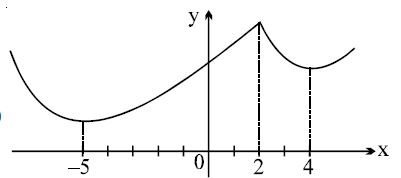
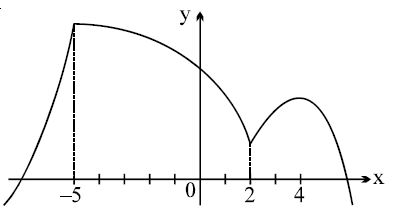
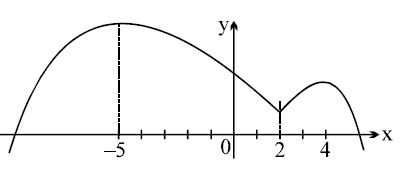
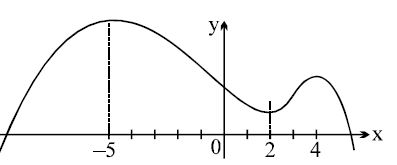
$(ii)$ $f'(-5) = 0$; $f'(2)$ is not defined and $f'(4) = 0$.
$(iii)$ $(-5, 12)$ is a point which lies on the graph of $f(x)$.
$(iv)$ $f''(2)$ is undefined,but $f''(x)$ is negative everywhere else.
$(v)$ The signs of $f'(x)$ are given below:
| $x$ | $(-\infty, -5)$ | $-5$ | $(-5, 2)$ | $2$ | $(2, 4)$ | $4$ | $(4, \infty)$ |
|---|---|---|---|---|---|---|---|
| $f'(x)$ | $+$ | $0$ | $-$ | Undefined | $+$ | $0$ | $-$ |
Possible graph of $y = f(x)$ is:
$(ii)$ $f'(-5) = 0$; $f'(2)$ is not defined and $f'(4) = 0$.
$(iii)$ $(-5, 12)$ is a point which lies on the graph of $f(x)$.
$(iv)$ $f''(2)$ is undefined,but $f''(x)$ is negative everywhere else.
$(v)$ The signs of $f'(x)$ are given below:
| $x$ | $(-\infty, -5)$ | $-5$ | $(-5, 2)$ | $2$ | $(2, 4)$ | $4$ | $(4, \infty)$ |
|---|---|---|---|---|---|---|---|
| $f'(x)$ | $+$ | $0$ | $-$ | Undefined | $+$ | $0$ | $-$ |
Possible graph of $y = f(x)$ is:
- A
- B
- C
- D
Explore More
Similar Questions
Let $f(x) = x^{13} + x^{11} + x^{9} + x^{7} + x^{5} + x^{3} + x + 12$. Then
MediumWBJEE 2020
View SolutionLet $f:[0, \infty) \rightarrow [0, 3]$ be a function defined by
$f(x) = \begin{cases} \max \{\sin t : 0 \leq t \leq x\}, & 0 \leq x \leq \pi \\ 2 + \cos x, & x > \pi \end{cases}$
Then which of the following is true?
$f(x) = \begin{cases} \max \{\sin t : 0 \leq t \leq x\}, & 0 \leq x \leq \pi \\ 2 + \cos x, & x > \pi \end{cases}$
Then which of the following is true?
DifficultJEE MAIN 2021
View SolutionLet $f(x) = \begin{cases} \frac{1}{|x|}, & |x| \geqslant 1 \\ ax^2 + b, & |x| < 1 \end{cases}$ be continuous and differentiable everywhere. Then $a$ and $b$ are
Let $f(x)$ be a polynomial of degree $6$ in $x$,in which the coefficient of $x^{6}$ is unity and it has extrema at $x=-1$ and $x=1$. If $\lim_{x \rightarrow 0} \frac{f(x)}{x^{3}}=1$,then $5 \cdot f(2)$ is equal to .............
DifficultJEE MAIN 2021
View SolutionObserve the following statements:
$I. f(x) = a x^{41} + b x^{-40} \Rightarrow \frac{f^{\prime \prime}(x)}{f(x)} = 1640 x^{-2}$
$II. \frac{d}{d x} \tan ^{-1}\left(\frac{2 x}{1-x^2}\right) = \frac{1}{1+x^2}$
Which of the following is correct?
$I. f(x) = a x^{41} + b x^{-40} \Rightarrow \frac{f^{\prime \prime}(x)}{f(x)} = 1640 x^{-2}$
$II. \frac{d}{d x} \tan ^{-1}\left(\frac{2 x}{1-x^2}\right) = \frac{1}{1+x^2}$
Which of the following is correct?
DifficultTS EAMCET 2005
View SolutionVedclass Products
For Students
Vedclass Test Series
Mock tests in real JEE/NEET style with performance analysis. 5-day free trial.
Start Free TrialFor Teachers
Exam Paper Generator
Generate Set A/B/C/D exam papers from 7.5L+ questions in 2 minutes. 3 chapters free.
Try FreeFor Institutes
Online Exam Module
Live online exams with unlimited students, 360° analytics & white-label branding.
See Demo